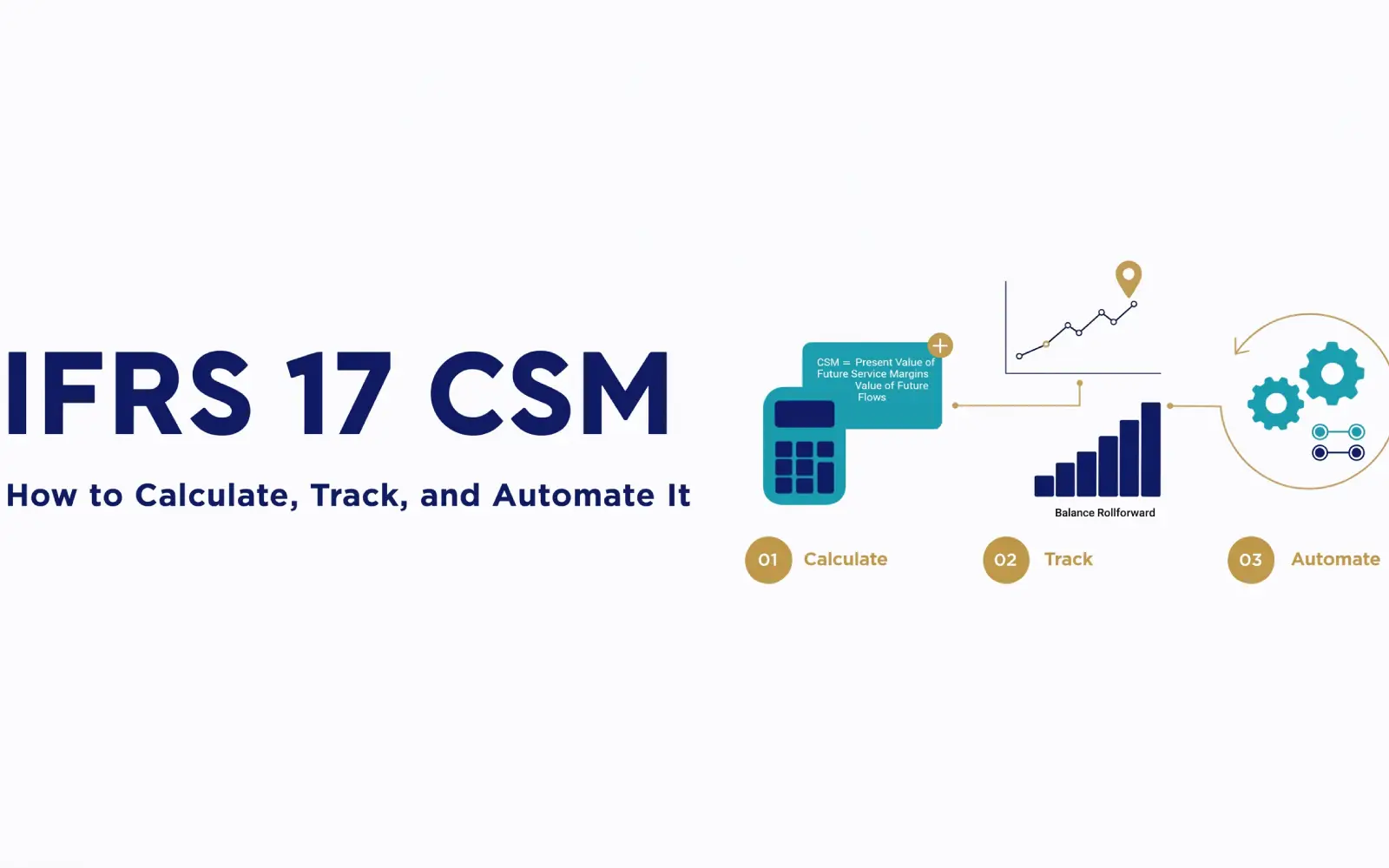
If you've spent any time around IFRS 17 implementation teams, you've probably heard the CSM described as the trickiest piece of the whole standard. And honestly? That reputation is well earned. The Contractual Service Margin sits at the heart of IFRS 17, representing the profit an insurer expects to earn as it delivers insurance coverage. Under the standard, that profit can't be pocketed upfront — it has to be released gradually, period by period, as services are actually provided.
For many insurers, this creates a real operational headache. CSM calculations depend on actuarial assumptions, discounted cash flows, and risk adjustments that shift over time. Tracking those shifts across hundreds of thousands — sometimes millions — of contracts, and reconciling them across reporting periods, quickly becomes unmanageable without the right infrastructure behind it.
So let's break it down properly: how CSM works, how it's calculated, what causes it to move, and how the right software can automate the process from initial recognition all the way through to final reporting.
What Is the Contractual Service Margin (CSM) Under IFRS 17?
The CSM is a liability component on an insurer's balance sheet representing unearned profit. Under IFRS 17, insurers cannot recognize profit the moment a contract is written. Instead, that profit is deferred into the CSM and released into the income statement over the coverage period as insurance services are delivered.
The CSM is one of three building blocks in the IFRS 17 General Measurement Model (GMM), alongside fulfilment cash flows and the risk adjustment for non-financial risk. Together, these three components make up the total insurance contract liability.
Here's an important nuance: the CSM only exists when a contract is profitable at inception. If the present value of expected outflows exceeds inflows — making the contract onerous — there's no CSM at all. Instead, that loss is recognized immediately, rather than smoothed out over time.
How Is IFRS 17 CSM Calculated at Initial Recognition?
At initial recognition, the CSM equals the difference between the present value of expected future cash inflows (premiums) and the present value of expected future cash outflows (claims and expenses), adjusted for the risk adjustment for non-financial risk.
Expressed simply:
CSM = Present value of inflows − Present value of outflows − Risk adjustment
Each input demands careful estimation:
- Fulfilment cash flows capture all expected future cash flows — premiums received, claims paid, and directly attributable expenses.
- Discounting adjusts those cash flows to reflect the time value of money, using current discount rates consistent with the characteristics of the liabilities.
- Risk adjustment reflects the compensation an insurer requires for bearing uncertainty in the amount and timing of cash flows.
Here's a simple example to make this concrete: an insurer writes a five-year life contract. The present value of expected premiums is $1,000. The present value of expected claims and expenses is $850. The risk adjustment is $50. The CSM at initial recognition is $1,000 − $850 − $50 = $100.
That $100 isn't booked as profit right away. Instead, it gets released into the income statement gradually, over the five years of coverage.
What Causes the IFRS 17 CSM to Change Over Time?
The CSM isn't a "set it and forget it" number — it moves. Several events cause it to increase or decrease after initial recognition:
- Changes in estimates of future cash flows — if expected future claims or expenses change, the adjustment flows into the CSM for profitable contracts, rather than hitting profit or loss directly.
- Changes in actuarial assumptions — updated discount rates and other assumption changes related to future services adjust the CSM.
- Experience adjustments — differences between actual and expected cash flows related to future services also feed into the CSM.
- Interest accretion — the CSM grows each period at the locked-in discount rate applied at contract inception.
- CSM release — as insurance services are provided, a portion of the CSM is released into the income statement based on coverage units.
Getting a handle on these movements isn't just an accounting exercise — it's essential for accurate financial reporting and for explaining profit recognition to stakeholders, auditors, and regulators alike.
What Is the IFRS 17 CSM Roll-Forward?
The CSM roll-forward is a reconciliation that tracks how the CSM balance moves from its opening position to its closing position in each reporting period. A typical roll-forward includes:
| Line item | Description |
|---|---|
| Opening CSM | Balance at the start of the period |
| New business | CSM added from newly written contracts |
| Interest accretion | Growth at the locked-in discount rate |
| Changes in estimates | Adjustments for updated cash flow projections |
| CSM release | Amount recognized in profit or loss |
| Closing CSM | Balance at the end of the period |
Roll-forward reconciliation is critical for audit compliance and for explaining period-on-period movements in reported profit. Discrepancies between actuarial estimates and financial outputs need to be fully traceable, which makes data integrity a non-negotiable requirement — not a nice-to-have.
Why Is CSM Tracking Difficult for Insurers?
On paper, CSM is conceptually clean. In practice, tracking it at scale creates genuine operational complexity. A few factors drive this:
- Volume — large portfolios may involve millions of individual contracts, each with its own CSM balance and assumptions.
- Data fragmentation — actuarial and finance teams often work in separate systems, making it hard to reconcile inputs.
- Manual processes — many insurers still lean on spreadsheets for CSM calculations and roll-forwards, which introduces version-control issues and error risk.
- Multiple reporting periods — restating prior periods, running parallel calculations, and managing comparative reporting all add layers of complexity.
- Audit requirements — regulators expect a complete audit trail showing how each CSM balance was derived, what changed, and why.
Put these factors together, and it's clear that manual CSM management isn't just inefficient. It carries real reporting and compliance risk. For a broader look at how these pressures show up across the entire standard, our post on 5 common IFRS 17 Challenges (And How to Overcome Them) digs into the issues insurers run into most often — and how to get ahead of them.
How Can Software Automate IFRS 17 CSM Management?
Purpose-built IFRS 17 software tackles these challenges by centralizing and automating the end-to-end CSM process:
- Centralized data management — a single source of truth for actuarial inputs, assumptions, and contract data eliminates fragmentation between teams.
- Automated calculations — software applies IFRS 17 calculation logic consistently across the entire portfolio, cutting down on manual effort and human error.
- Automated roll-forwards — the system generates roll-forward reconciliations automatically, flagging variances for review.
- Reconciliation and validation controls — built-in validation rules catch inconsistencies before they reach financial statements.
- Audit trails — every calculation, assumption change, and adjustment is logged with a timestamp and user record.
- Reporting workflows — automated reporting shrinks the gap between period-end close and financial statement preparation.
When actuarial and finance systems are properly integrated, data flows directly into the CSM calculation engine, eliminating the manual handoffs that slow reporting cycles and introduce errors. If you're curious how that integration actually works in practice, our post on IFRS 17 Data Integration: Connecting Actuarial, Finance, and Reporting Systems walks through it in detail. And if your portfolio includes contracts measured under the simplified approach, it's worth pairing this with our breakdown of IFRS 17 PAA Calculations: How Insurance Software Can Reduce Manual Work and Reporting Errors.
What Should Insurers Look for in IFRS 17 CSM Software?
Not all IFRS 17 platforms handle CSM with the same depth. When evaluating options, insurers should prioritize:
- CSM calculation accuracy — full support for the GMM, Variable Fee Approach (VFA), and Premium Allocation Approach (PAA) where applicable.
- Automated roll-forward generation — period-end reconciliations produced automatically, with drill-down capability.
- Data integration — seamless connections to actuarial modeling tools and finance systems.
- Validation and reconciliation controls — pre-built rules that catch errors at the source.
- Audit trail and version control — complete traceability for regulatory review.
- Scalable architecture — the ability to handle large contract volumes across multiple legal entities and geographies.
- Reporting flexibility — support for both local regulatory reporting and group-level IFRS 17 disclosures.
Subject-matter expertise matters just as much as the platform itself. Software configured without deep IFRS 17 knowledge can produce technically compliant outputs that are still difficult to audit or explain. Look for vendors who pair platform capability with real actuarial and accounting expertise. For a more complete evaluation checklist, our guide on How to Choose the Right IFRS 17 Software for Your Insurance Firm covers what to ask vendors before you commit. And if you're looking at the reporting side specifically, IFRS 17 Disclosure Automation: Simplify Reporting, Improve Accuracy is a useful companion read.
How iBOS Supports IFRS 17 CSM Calculation and Reporting
One platform from initial recognition to automated reporting
iBOS is an IFRS 17 solution built to manage the full lifecycle of insurance contract measurement — from initial CSM recognition through to automated reporting.
The platform supports CSM and reserve calculations across measurement models, automates roll-forward reconciliations, and integrates with both actuarial and financial reporting systems. Automated reporting workflows cut down on the manual effort involved in period-end close, and full audit trails support regulatory review.
Critically, iBOS pairs software capability with subject-matter expertise. Implementation is supported by specialists with deep knowledge of IFRS 17 requirements, ensuring the platform is configured to produce outputs that are accurate, auditable, and aligned with the standard's requirements. For a wider view of how iBOS handles the entire reporting lifecycle — not just CSM — take a look at IFRS 17 Software: How Insurance Can Manage the Complete Reporting Lifecycle from Data to Disclosure. And if your organization operates under Takaful principles, our roadmap on Implementing IFRS 17 For Takaful: A Practice Roadmap for Islamic Insurers addresses the specific considerations that come with that model.
For insurers managing complex portfolios across multiple entities, iBOS provides the infrastructure to bring CSM management firmly under control.
Ready to Simplify Your IFRS 17 CSM Process?
CSM is one of the most technically demanding aspects of IFRS 17. The calculation logic is precise, the tracking requirements never really stop, and the audit expectations are high. For insurers still running these processes on spreadsheets or fragmented systems, the risks — operational and reputational — are significant.
Automation doesn't just lighten the workload. It improves the accuracy and consistency of CSM calculations, speeds up reporting cycles, and gives finance and actuarial teams a shared, auditable source of truth they can both stand behind.
If your organization is working through IFRS 17 CSM challenges right now, iBOS offers a proven path toward greater efficiency and control.
Frequently Asked Questions
What is CSM in IFRS 17?
The Contractual Service Margin (CSM) is the component of an insurance contract liability that represents unearned profit under IFRS 17. It's recognized at initial measurement and released into the income statement over the coverage period as insurance services are provided.
How is the IFRS 17 CSM calculated at initial recognition?
CSM is calculated as the present value of expected future cash inflows (premiums) minus the present value of expected future cash outflows (claims and expenses), minus the risk adjustment for non-financial risk. The result is the profit deferred into the CSM at contract inception.
What is a CSM roll-forward?
A CSM roll-forward is a period-by-period reconciliation that tracks movements in the CSM balance, including new business added, interest accretion, changes in estimates, and the amount released to profit or loss. It's a core disclosure requirement under IFRS 17.
What causes the CSM to change after initial recognition?
The CSM changes due to interest accretion, changes in estimates of future cash flows, changes in actuarial assumptions related to future services, experience adjustments, and the release of CSM as insurance services are delivered.
What is CSM release?
CSM release is the portion of the CSM recognized in the income statement each period, reflecting the insurance services provided during that period. The release is calculated based on coverage units — a measure of the relative service provided in the current period versus remaining future periods.
Can IFRS 17 CSM calculations be automated?
Yes. Purpose-built IFRS 17 software can automate CSM calculations, roll-forward reconciliations, assumption updates, and reporting workflows. Automation reduces manual effort, improves calculation accuracy, and produces the audit trails required for regulatory compliance.
What should insurers look for in CSM software?
Key capabilities include accurate CSM calculation across IFRS 17 measurement models, automated roll-forward generation, data integration with actuarial and finance systems, built-in reconciliation controls, a complete audit trail, and scalable architecture for large or complex portfolios.